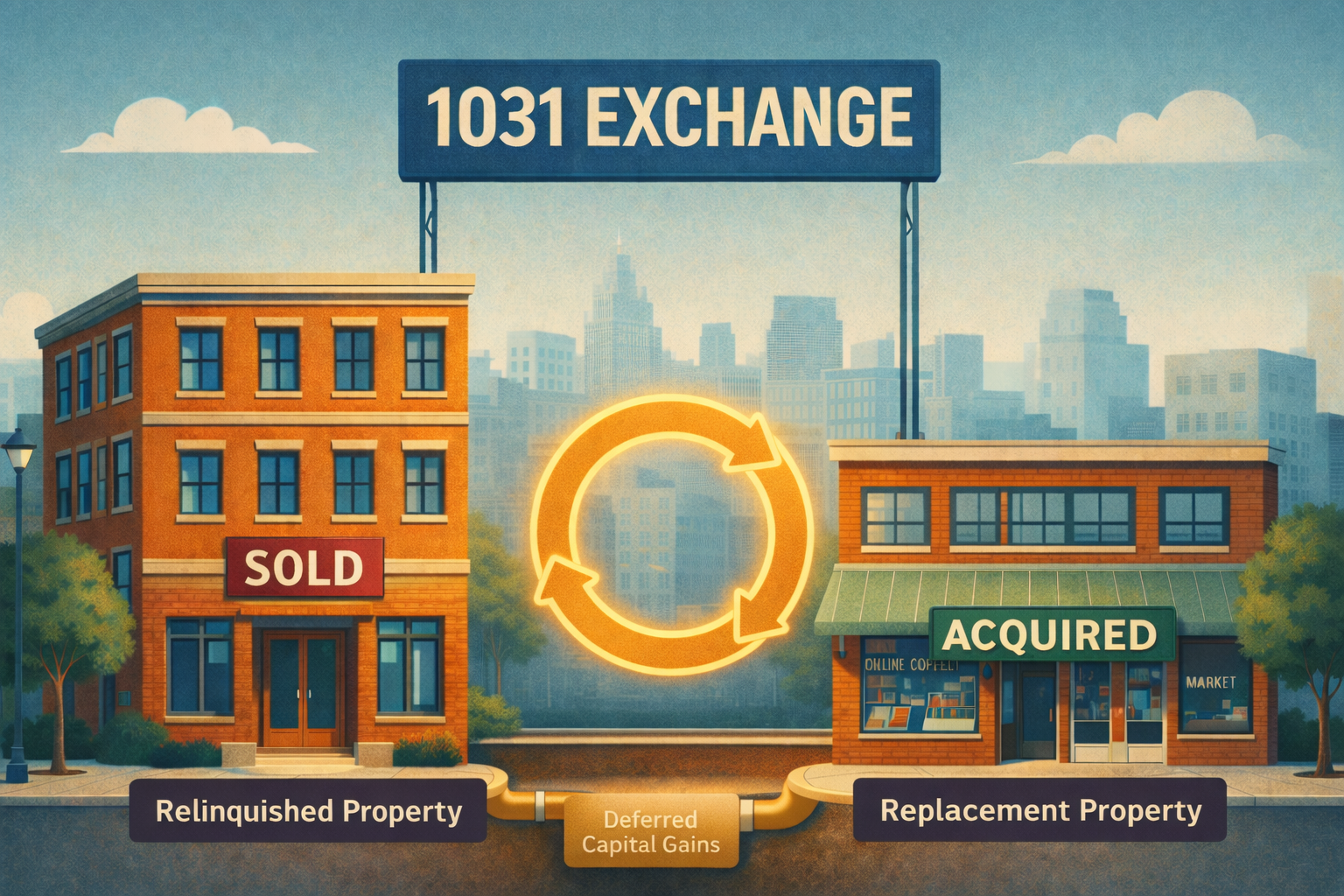
The Quiet Power of a 1031 Exchange
How Real Estate Investors Legally Defer Taxes and Compound Wealth
According to the National Association of Realtors, roughly $100 billion of U.S. real estate transactions each year involve Section 1031 like-kind exchanges. Yet many investors misunderstand how narrow, and powerful, the rule actually is.
The real advantage is simple: investors reinvest pre-tax capital instead of after-tax capital, which can materially change long-term compounding.
1031 exchanges involve strict IRS rules and should always be executed with qualified tax and legal professionals.
Understanding where this tool fits, and where it doesn’t, is critical for investors evaluating private real estate opportunities.
The 1031 Exchange: How Real Estate Investors Defer Taxes, and When It Actually Matters
The 1031 exchange comes from Section 1031 of the U.S. Internal Revenue Code, originally enacted in 1921.
Its purpose was simple: allow investors to sell productive real estate and reinvest in other productive real estate without being taxed immediately on the gain.
The key word is deferred. The tax is not eliminated. It simply moves forward into the next property.
What a 1031 Exchange Actually Does
A 1031 exchange is best understood as a tax deferral mechanism, not an investment strategy.
Mechanically, it works because the IRS treats the transaction as a continuation of the original real estate investment, not a taxable “exit.”
- An investor sells a property that has appreciated in value.
- Normally, that sale would trigger capital gains tax, depreciation recapture, and often state taxes.
- Instead of recognizing the gain, the investor reinvests the proceeds into another qualifying property.
- If the rules are followed correctly, the gain is rolled forward into the new property.
- The tax obligation remains embedded in the new asset’s cost basis.
Important clarification on “like-kind”: like-kind does not mean identical. Nearly all U.S. investment real estate is considered like-kind to other U.S. investment real estate, meaning an investor can typically exchange land for apartments, retail for industrial, or one property for several (as long as the replacement(s) are held for business or investment).
Visual: 1031 Capital Flow (Simple Version)
Property Sale
Investor sells appreciated investment property.
Qualified Intermediary
Proceeds held so investor never “touches” cash.
Replacement Property
Investor buys qualifying real estate; gain is deferred.
When market structure, credit conditions, or capital flows shift, I send a short analysis of what it means for risk, liquidity, and cash flow resilience.
Only when something actually changes.
Get the next Back9 Signal →
Where the Deferral Actually Happens
The tax deferral occurs because the IRS treats the transaction as a continuation of the original investment rather than a completed sale.
Here’s a simplified example:
Example: Same Sale, Two Different Outcomes
Starting Numbers
- Original purchase price: $1,000,000
- Current sale price: $2,000,000
- Gain: $1,000,000
(Actual taxes vary with depreciation, state rules, and your bracket.)
Without a 1031
Investor recognizes the gain and pays taxes now. That can reduce reinvestable capital by hundreds of thousands of dollars.
With a 1031
Investor reinvests the full proceeds into a replacement property and carries the tax basis forward. Taxes are deferred, not eliminated.
- How does a 1031 exchange actually defer taxes?
- What qualifies as “like-kind” property in an exchange?
- What timelines and rules must investors follow?
- Where do investors usually run into problems with exchanges?
- How do experienced investors use 1031 exchanges to reposition a portfolio?
The Rules That Make It Work
The IRS allows this deferral only if several strict rules are followed. Four matter most:
- Like-kind requirement: both properties must be investment or business real estate (primary residences do not qualify).
- 45-day identification window: after the sale, you have 45 days to identify replacement options in writing to your Qualified Intermediary.
- 180-day closing deadline: the replacement property must close within 180 days of the sale (these clocks run concurrently).
- Full deferral requirements: to fully defer tax, you generally need to reinvest all exchange proceeds and replace debt with equal or greater leverage (or contribute additional equity).
The three common identification methods:
- 3-Property Rule: identify up to three potential replacement properties, regardless of value.
- 200% Rule: identify more than three properties as long as their total value does not exceed 200% of the relinquished property’s value.
- 95% Rule: identify any number of properties if you ultimately acquire at least 95% of the total value identified.
To ensure the investor never touches the proceeds directly, the transaction is managed by a Qualified Intermediary. If the investor receives the cash at any point, the exchange can fail and taxes are triggered.
Visual: 1031 Timing (The Two Clocks)
Day 0 — Sale closes
Day 45 — Identification deadline
Day 180 — Replacement must close
Risks and Misconceptions
Many investors assume a 1031 exchange is a universal tax solution. It is not.
- Timing pressure: the 45-day window can force suboptimal decisions if replacement options aren’t ready.
- Full reinvestment requirements: to defer fully, you generally need to reinvest all equity and replace debt at equal or greater levels. Cash taken out is often taxable.
- Operational complexity: coordination across advisors, escrow, lenders, and the intermediary is non-negotiable. Mistakes can invalidate the exchange.
This is why some investors choose to exchange into professionally managed properties or passive structures rather than sourcing replacement deals themselves.
One additional risk that shows up in the real world: forced asset allocation. Investors sometimes accept inferior replacement properties simply to avoid triggering taxes. The tax tail can end up wagging the investment dog.
Example Walkthrough
Consider an investor who purchased a small apartment building for $2 million ten years ago. Through appreciation and rent growth, the property is now worth $4 million.
If the investor sells normally, the combination of capital gains and depreciation recapture can create a large tax bill. Instead, the investor performs a 1031 exchange and rolls the proceeds into a replacement property or a diversified real estate portfolio.
Because the tax is deferred, more capital stays invested, which can materially change the compounding path across multiple investment cycles.
Used correctly, a 1031 exchange lets you keep more capital working — but it also forces you to make decisions on a clock.
Investor Lens: Does This Apply to You?
For most accredited investors, the answer depends on one simple question: Do you currently own appreciated investment real estate?
The 1031 exchange is primarily useful for investors who own rental or commercial properties that have appreciated and want to redeploy without triggering immediate taxes.
If you’re investing fresh cash into a syndication, fund, or private credit strategy, there is no property sale to exchange. In that case, a 1031 exchange is not relevant.
Where this gets interesting is when investors use a 1031 exchange to transition from active ownership into more passive real estate exposure — selling what they personally manage and exchanging into professionally managed assets.
How Experienced Investors Handle the Replacement Problem
If you’ve ever watched someone try to source a great replacement property inside 45 days, you see the real constraint: execution speed. That’s why many experienced investors use structures designed to make the “replacement” step easier without going fully active again.
Two Common “Passive-Friendly” Replacement Options
Delaware Statutory Trust (DST)
A DST is a structure where investors purchase beneficial interests in a trust that owns institutional real estate. In many cases, DST interests can qualify as 1031 replacement property. The trade-off is control: you’re buying into a predefined asset and business plan.
Use case: exchanging out of active ownership into more passive, professionally managed exposure.
Tenants-in-Common (TIC)
A TIC is fractional co-ownership of real property, where each investor owns an undivided interest. Properly structured TIC interests can sometimes be used in 1031 planning, but they require more coordination and have more operational complexity than DSTs.
Use case: splitting ownership, tailoring exchange amounts, or coordinating multiple sellers where “same taxpayer” constraints matter.
The point isn’t that one is “better.” The point is that sophisticated investors plan the replacement leg before the sale closes — and they choose structures that reduce deadline-driven decision-making.
Quick Takeaways
- A 1031 exchange is a tax deferral tool, not a return enhancer by itself.
- It applies when you sell appreciated investment real estate and reinvest into qualifying real estate.
- The two clocks (45 days + 180 days) create real execution risk.
- Used well, it can keep more capital compounding across cycles.
Some investors treat 1031 exchanges as a multi-decade compounding strategy. By continually rolling gains forward into new properties, capital stays invested rather than taxed along the way. Under current law, a step-up in basis at death can reset the deferred gain for heirs, which is why the strategy is sometimes described as “swap until you drop.”
Next Step
If you’re evaluating whether selling a property and redeploying the capital makes sense, the structure of the next investment becomes critical. Some investors exchange into another single property. Others exchange into diversified portfolios or passive real estate strategies.
Understanding these mechanics before a sale happens can materially change the outcome of the decision.
If you'd like to talk through real examples, what you own, what you're selling, and what replacement paths actually fit, I'm always happy to have a short conversation.

This article is for educational purposes only and does not constitute investment advice or an offer to sell securities.