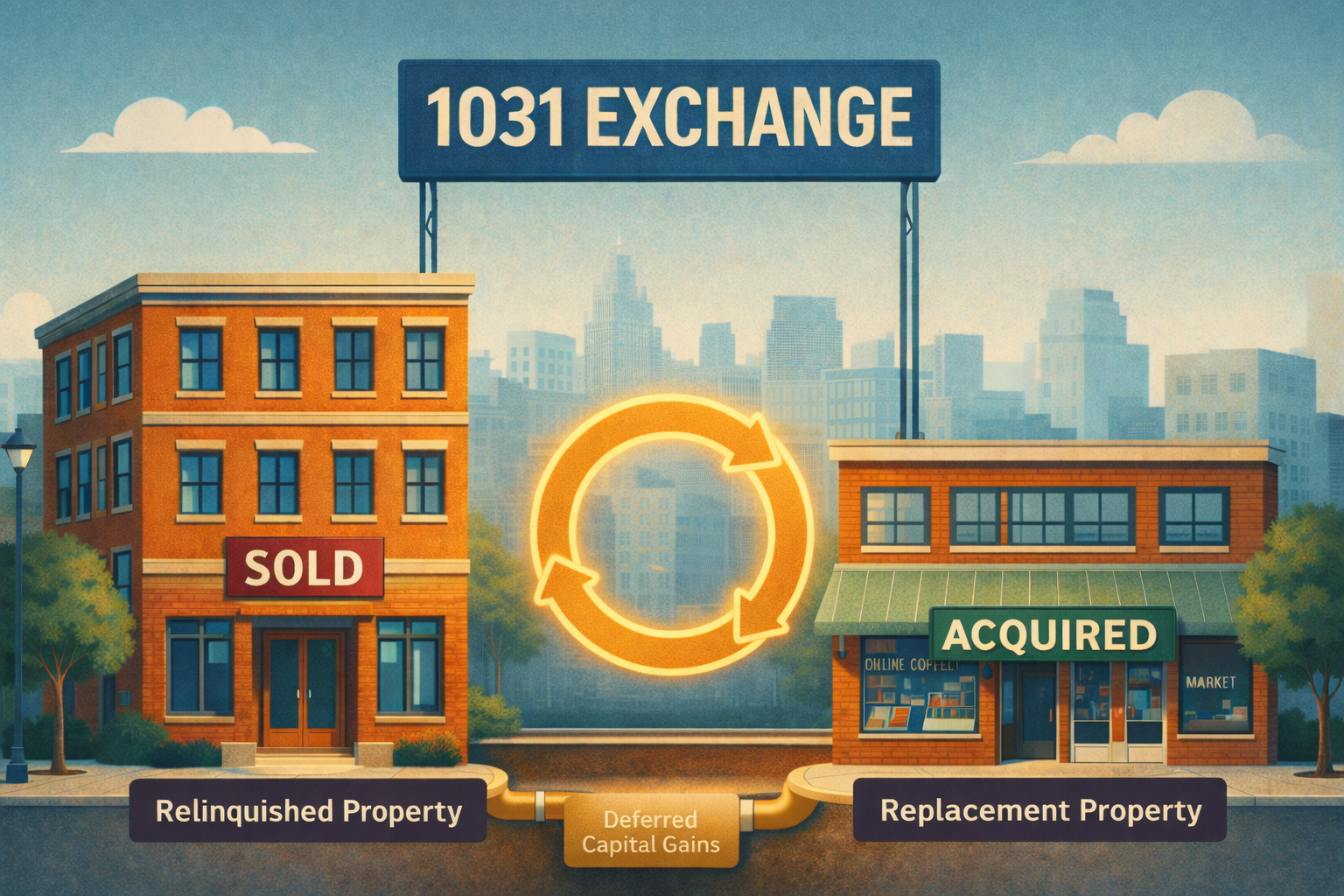
The Quiet Power of a 1031 Exchange
How real estate investors defer taxes and keep capital working
According to the National Association of Realtors, roughly $100 billion of U.S. real estate transactions each year involve Section 1031 exchanges.
That number tells you something important. Sophisticated real estate investors rely on this rule constantly. Family offices, long-time landlords, and institutional operators use it for a simple reason. A 1031 exchange allows an investor to sell appreciated investment real estate and reinvest into another qualifying property without immediately recognizing capital gains taxes.
The gain is not eliminated. It carries forward into the replacement property.
In many cases, the difference between using this rule and ignoring it can mean hundreds of thousands of dollars staying invested instead of going to taxes.
What a 1031 Exchange Actually Does
A 1031 exchange is a tax deferral tool, not an investment strategy. When an investor sells an appreciated property, capital gains, depreciation recapture, and often state taxes can reduce the amount available to reinvest.
A 1031 exchange allows the IRS to treat the transaction as a continuation of the original investment. The gain moves forward into the next property instead of being taxed immediately. That allows investors to reinvest pre-tax capital, which can materially improve long-term compounding.
Investor translation: A 1031 exchange does not create returns. It preserves capital efficiency so more dollars stay invested between property cycles.
Why the Rule Exists
The rule dates back more than a century. Congress introduced the concept in 1921 to keep capital reinvesting in productive real estate rather than exiting after each sale.
The name “1031” is simply the section of the U.S. Internal Revenue Code where the rule lives today. The intent is straightforward. If an investor sells one investment property and immediately reinvests into another, the property changes but the capital stays deployed.
How It Works
An investor sells an appreciated investment property. The proceeds are held by a Qualified Intermediary so the investor never receives the cash directly. The investor then acquires a qualifying replacement property. If executed correctly, the gain remains deferred.
Cash Flow Engine
Investor sells investment real estate.
Investor does not take possession of cash.
Gain remains deferred if rules are followed.
When market structure, credit conditions, or capital flows shift, I send a short analysis of what it means for risk, liquidity, and cash flow resilience.
Only when something actually changes.
Get the next Back9 Signal →
Key Rules
The rules are strict, but the framework is simple once you see the moving parts.
- Like-kind property: Most U.S. investment real estate qualifies as like-kind to other U.S. investment real estate.
- 45 days: Replacement properties must be identified within 45 days of the sale.
- 180 days: The replacement property must close within 180 days of the sale.
- Reinvest fully: To fully defer tax, investors generally reinvest all proceeds and replace existing debt (or add equity).
Identification is usually done using the 3-Property Rule, the 200% Rule, or, more rarely, the 95% Rule.
Lifecycle Timeline
Sale closes
Identify replacement property options
Close on replacement property
Have questions about 1031 exchanges?
You can ask the Back9 assistant things like:
What are the key deadlines in a 1031 exchange?
What happens if I miss the 45-day identification window?
Can I use a 1031 to buy multiple replacement properties?
How does a DST fit into a 1031 strategy?
What are the biggest mistakes investors make with 1031s?
When This Structure Matters
A 1031 exchange becomes relevant when an investor already owns appreciated investment real estate. If you are investing fresh capital into a fund or syndication, there is no property sale to exchange.
Even if you are not planning to sell anytime soon, understanding how this works before a sale happens can change how you approach the decision. This is why many experienced investors learn the rules long before they actually need them.
Quick Takeaways
- A 1031 exchange helps investors control when taxes are recognized.
- It can preserve reinvestable capital and reduce tax drag on compounding.
- The tradeoff is strict timing rules and careful execution.
Educational content only. Investors should consult qualified tax and legal advisors before executing a 1031 exchange.
Next Step
If you are considering selling a property, understanding the mechanics of a 1031 exchange becomes critical. Those decisions are where experienced investors quietly separate themselves from everyone else.
Read the Deep Dive: The 1031 Exchange (full rules, examples, and replacement strategies sophisticated investors actually use).
Decision Fork
You are here. Quick Read.
Read the Deep Dive: The 1031 Exchange.
Talk through a real example before you sell.
If you'd like to talk through how these structures work, I'm always happy to have a short conversation.
Book a short call with Mitch